
COMPLIANCE GUIDE - UPDATED FOR 2026
SMS Compliance Guide: Text Message Marketing Laws, Opt-In Rules and 10DLC
Before you send a marketing text, you need permission, the right
disclosures, a working opt-out and a registered number. This guide explains the federal TCPA rules, carrier requirements and state laws that apply to text message marketing in the US, with copy-ready compliant messages.
Updated October 2026 · 8 min read · 8 templates
SMS compliance checklist
- Get prior express written consent before sending marketing texts, and keep a record of it.
- Show the required disclosures wherever people opt in: program, frequency, rates, HELP and STOP, terms and privacy.
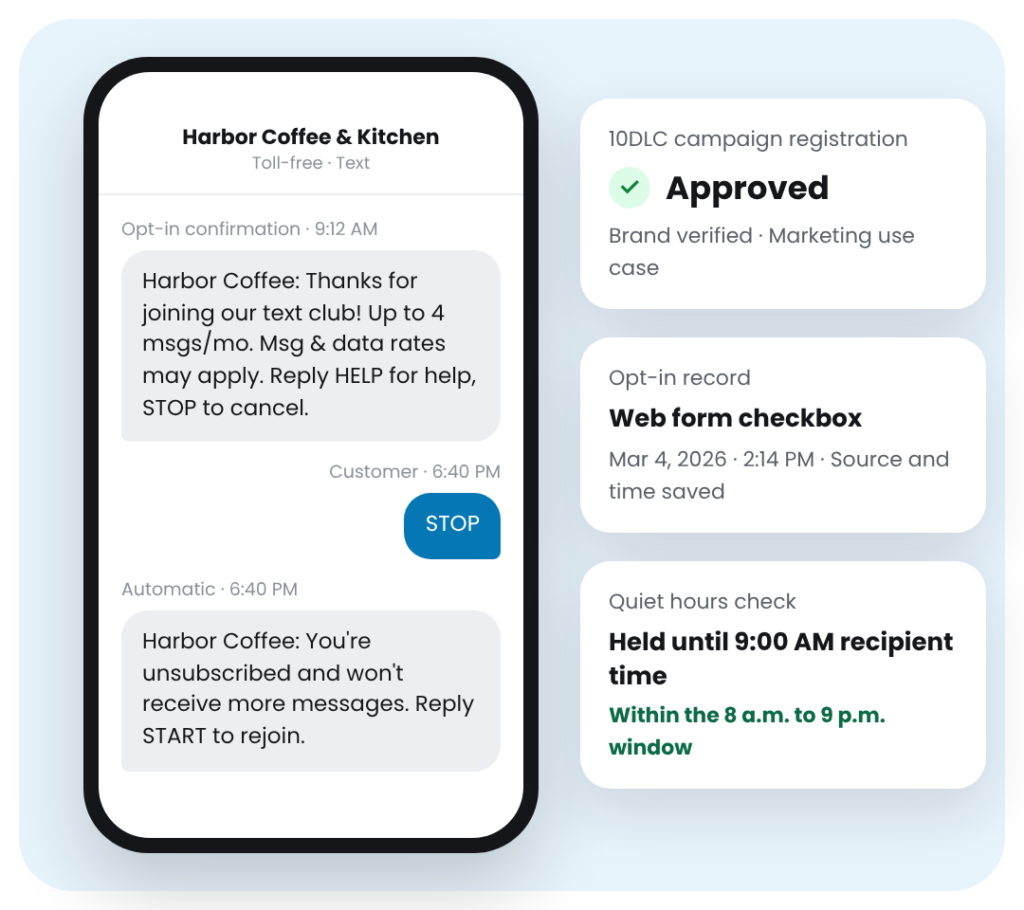
- Send a confirmation text right after someone joins.
- Honor opt-outs made in any reasonable way, including STOP, QUIT, END, REVOKE, OPT OUT, CANCEL and UNSUBSCRIBE.
- Text only between 8 a.m. and 9 p.m. in the recipient’s time zone, or a narrower window where state law requires it.
- Register your brand and campaign for 10DLC, or verify your toll-free number, before you send.
This guide is not legal advice.
Who regulates text message marketing
The Federal Communications Commission (FCC) enforces the Telephone Consumer Protection Act (TCPA), the main federal law for marketing texts. The Federal Trade Commission (FTC) polices deceptive offers and telemarketing practices.
Wireless carriers and the CTIA, their industry association, set the rules for what traffic they will deliver. They can filter or block messages that break those rules even when no law is broken. Many states add their own laws on top.
TCPA rules for text messages
Under the TCPA, a text message counts as a call. Marketing texts sent with automated
technology require prior express written consent: a clear, signed agreement (a checked box or a
texted keyword counts) to receive marketing texts at that number.
Consent cannot be a condition of buying anything. National Do Not Call Registry protections
also apply to marketing texts. Violations carry statutory damages of $500 per message, up to
$1,500 if willful, which is why TCPA class actions are common.
SMS opt-in requirements
Wherever someone opts in, on a web form, a sign, a kiosk or a paper form, show these disclosures: the program name, how often you will text, that message and data rates may apply, how to get help (HELP) and opt out (STOP), and links to your terms and privacy policy. Say that consent is not required to buy.
With double opt-in, the first text asks the person to reply YES before you send anything else. It is not required by law, but it gives you the clearest record of consent.
Compliant message templates
Replace the [brackets] with your details. Every message should tell people how to opt out.
[Business]: Thanks for joining our text club! Up to 4 msgs/mo. Msg & data rates may apply. Reply HELP for help, STOP to cancel. Terms: [link]
[Business]: Reply YES to get deals and updates by text, up to 4 msgs/mo. Consent not required to buy. Msg & data rates may apply. Reply STOP to cancel.
[Business]: You’re in! Watch for your first offer this week. Reply HELP for help, STOP to cancel.
[Business]: Thanks for checking in! You’re now earning rewards by text, up to 4 msgs/mo. Msg & data rates may apply. Reply STOP to cancel.
[Business]: Text alerts and offers. Up to 4 msgs/mo. Questions? Call [phone] or visit [link]. Reply STOP to cancel.
[Business]: You’re unsubscribed and won’t receive more messages. Reply START to rejoin.
[Business]: 20% off everything this weekend. Show this text at checkout. Reply STOP to opt out.
By checking this box, I agree to receive
recurring marketing texts from [Business] at the
number provided, sent with automated technology. Consent is not a condition of purchase. Msg frequency varies. Msg & data rates may apply. Reply HELP for help, STOP to cancel. Terms: [link] Privacy: [link]
Compliance tools are built into every plan
Plans from $59 a month. Every plan includes a toll-free number and phone support.
How to collect compliant opt-ins
Text-to-join keyword
Post “Text JOIN to [number]” with the disclosures on the same sign or ad.
Web form checkbox
Use an unchecked box with the
disclosure text next to it.
Paper form or QR code
Include the full disclosure and keep the signed form or scan record.
Opt-out rules: STOP and beyond
FCC rules in effect since April 11, 2025 require you to honor an opt-out made in any reasonable way. Replies of STOP, QUIT, END, REVOKE, OPT OUT, CANCEL or UNSUBSCRIBE always count, and so does a reply like “please stop texting me.”
Process opt-outs within 10 business days; good platforms do it instantly. You may send one confirmation text, ideally within five minutes, and nothing after that. In September 2026 the FCC adopted further changes to these rules that take effect after publication, so check back for updates.
Quiet hours: when you can send marketing texts
Federal rules limit telephone solicitations to 8 a.m. to 9 p.m. in the recipient’s local time zone. Several states set a narrower window, so schedule campaigns by the recipient’s time zone, not yours.
SMS marketing laws by state
Some states have their own “mini-TCPA” laws with stricter consent rules, shorter sending windows or registration requirements. These are the ones most likely to affect a text marketing program:
|
State
|
Sending hours (recipient time)
|
What's different
|
|---|---|---|
|
Connecticut
|
9 a.m. to 8 p.m.
|
Written consent for telemarketing texts, except to existing customers who haven’t opted out
|
|
Florida (FTSA)
|
8 a.m. to 8 p.m.
|
Written consent for automated marketing texts; senders get 15 days to honor a STOP before a suit; $500 to $1,500 per
message
|
|
Maryland
|
8 a.m. to 8 p.m.
|
Written consent for automated marketing calls and texts (Stop the Spam Calls Act, 2024)
|
|
Oklahoma (OTSA)
|
8 a.m. to 8 p.m.
|
Written consent for automated marketing texts; consumers can sue
|
|
Pennsylvania (SB 992)
|
9 a.m. to 7 p.m.; no Sundays or legal holidays
|
Since October 18, 2026, marketing texts count as telephone solicitation; texts sent with written consent or to customers
from the past 12 months are exempt
|
|
Texas (SB 140)
|
9 a.m. to 9 p.m. Mon-Sat; noon to 9 p.m. Sun
|
Marketing texts count as telephone solicitation; some senders must register with the Secretary of State unless exempt
|
|
Washington (CEMA)
|
Federal window
|
Commercial texts without consent are prohibited; consumers can sue
|
Laws change often, and other states have passed newer rules. Sending between 9 a.m. and 7 p.m., Monday through Saturday, in the recipient’s time zone fits every window above.
10DLC registration and toll-free verification
Carriers block business texts from unregistered numbers. Since February 1, 2025, unregistered traffic on standard 10-digit numbers (10DLC) is blocked; register your brand and each campaign through The Campaign Registry first.
Toll-free numbers must pass toll-free verification; unverified toll-free messages have been blocked since January 31, 2024. Short codes go through their own carrier approval.
Restricted content carriers block (SHAFT)
Carriers restrict content about sex, hate, alcohol, firearms and tobacco, often called SHAFT, plus cannabis, vaping and some financial offers. Legal businesses in these categories may need age verification and extra carrier approval. Public link shorteners also trigger filtering, so use a branded or platform link.
How iVision Mobile keeps you compliant
Every iVision Mobile plan handles STOP and HELP replies automatically, blocks or warns about sends outside quiet hours, and keeps a timestamped record of every opt-in. Our team registers your 10DLC brand and campaign or verifies your toll-free number for you, and the platform is 100% opt-in: we never sell or share contact lists.
Frequently asked questions
What is SMS compliance?
SMS compliance means following the laws and carrier rules for business texting: getting consent, giving required disclosures, honoring opt-outs, respecting quiet hours and registering your number.
Do I need consent to send marketing texts?
Yes. Marketing texts sent with automated technology require prior express written consent, such as a checked box on a form or a texted keyword with the required disclosures. Keep a record of when and how each person opted in.
What time can I send marketing text messages?
Federal rules allow 8 a.m. to 9 p.m. in the recipient’s time zone. Some states are stricter: Florida, Oklahoma and Maryland allow 8 a.m. to 8 p.m., Connecticut 9 a.m. to 8 p.m., and Pennsylvania 9 a.m. to 7 p.m. with no texts on Sundays or legal holidays.
What happens if I don’t register for 10DLC?
Carriers block business texts sent from unregistered 10-digit numbers. Register your brand and campaign through The Campaign Registry before you send. iVision Mobile handles the registration for you.
How quickly do I have to honor an opt-out?
FCC rules allow up to 10 business days, but best practice is immediately. Accept STOP and other reasonable requests, like “please stop texting me.” iVision Mobile processes STOP replies automatically.
Does GDPR apply to SMS marketing?
Only if you text people in the European Union. This guide covers US rules. For EU contacts, GDPR and local e-privacy laws require clear opt-in consent and an easy way to withdraw it.
What are the penalties for violating the TCPA?
Statutory damages are $500 per message, up to $1,500 per message if the violation is willful. Because every text counts, class actions can reach millions of dollars, and some state laws add their own damages.
Text with confidence
Try iVision Mobile free for 14 days. No credit card required.
Additional SMS marketing guides for your industry
Restaurants
Fill slow nights with text-only offers, reward repeat visits through the kiosk and confirm reservations by text.
Retail
Announce new arrivals and sales, send mobile coupons and bring shoppers back with VIP-only texts.
Real Estate
Answer listing inquiries in minutes, promote open houses and stay in touch with past clients.
Car dealerships
Follow up on leads, book test drives and fill the service lane with reminders and two-way chat.
Nonprofits
Raise more with text-to-give appears, fill events and rally volunteers in hours, not days.
Sports & Entertainment
Grow fan lists at the venue, run text-to-win contests and sell more tickets and merchandise.